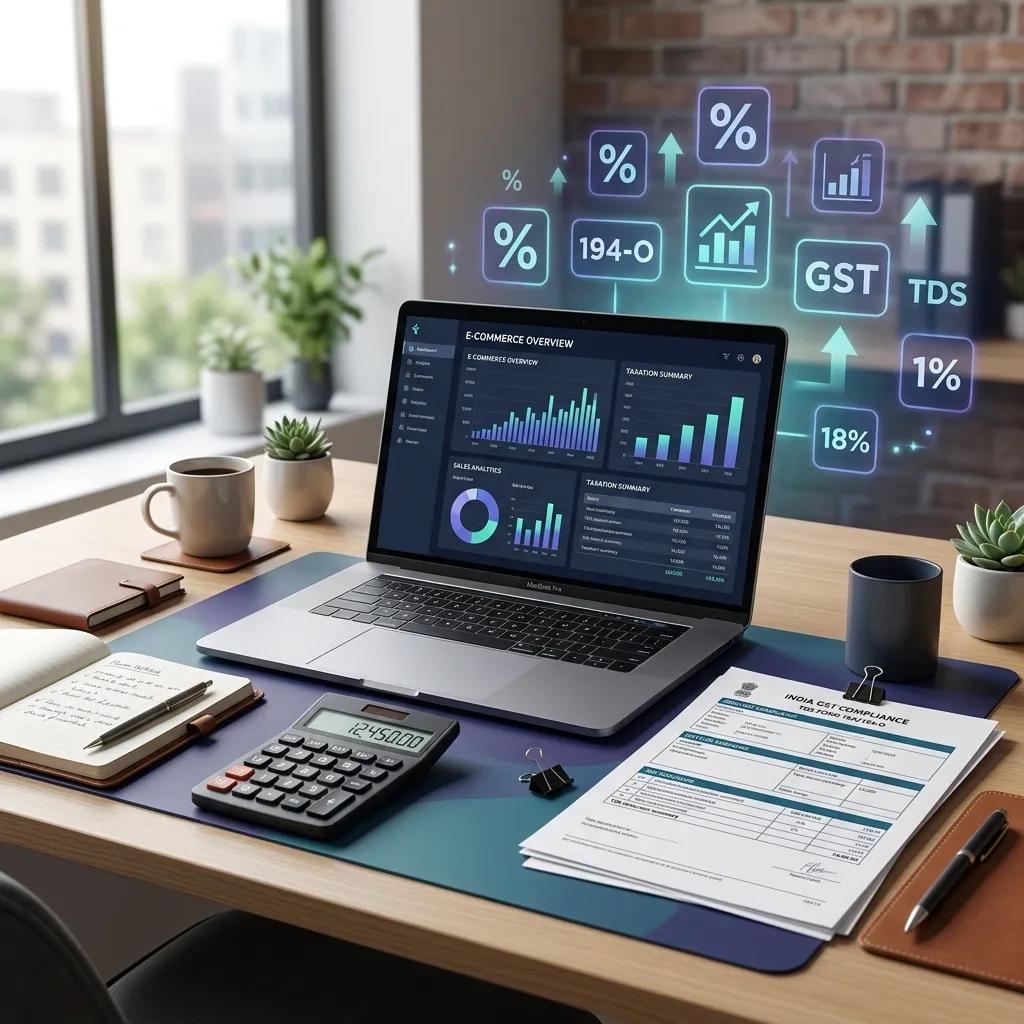
A Meesho seller may encounter GST on sales and purchases, income-tax TDS, and GST TCS in the same month. They are different records. The safest way to understand a payout is to trace each amount from the order and payment report to the appropriate tax portal. A single percentage applied to every order will miss returns, adjustments, eligibility rules and timing.
First, keep three columns separate
| Item | Where to check | What it answers |
|---|---|---|
| GST on sales and business purchases | Tax invoices, GST returns and GSTR-2B | What tax applies to your supplies and which purchase credits may be eligible |
| Income-tax TDS | Marketplace payment report and Income Tax portal records | What income-tax amount the operator reported as withheld |
| GST TCS | Marketplace statement and GST portal cash-ledger records | What collection was reported under the GST e-commerce rules |
Neither a reduced bank payout nor a line labelled “tax” tells you, by itself, whether an amount is a final expense. Keep the commercial margin calculation, bank receipt and tax ledger as separate views.
GST on a sale is different from input tax credit
The GST rate for an item depends on its correct classification and current law. Avoid assigning one rate to all clothing, electronics or cosmetics. Check the product's HSN classification and the applicable rate with your tax professional before setting the listing details and issuing invoices.
A registered seller may be able to claim input tax credit on eligible business purchases or services, including some logistics invoices. Eligibility is conditional. The GST portal explains that GSTR-2B is an auto-drafted ITC statement used when preparing GSTR-3B, and that taxpayers must still assess whether a credit is available. Match the supplier's GSTIN, invoice number, tax amount and the goods or service received. Do not book a credit merely because a percentage appears in a seller blog.
If a logistics invoice is missing from GSTR-2B or carries incorrect details, keep the invoice and payment evidence, then follow the Supplier Panel support route and your accountant's correction process. Our shipping GST and ITC guide covers that document check in more detail.
Marketplace TDS: which income-tax Act applies in 2026?
Income-tax withholding by an e-commerce operator may appear in the payment statement even when the platform advertises zero sales commission. The Income Tax Department's transition guidance says to use the earlier of credit or payment: an event on or before 31 March 2026 is governed by the Income-tax Act, 1961; an event on or after 1 April 2026 is governed by the Income-tax Act, 2025. For the new Act, TDS provisions are in section 393, and the applicable table item depends on the transaction. Check the rate, threshold and reporting details for the period rather than copying an old section number or percentage into every reconciliation.
Compare the amount withheld in the Meesho statement with the income-tax information for the same business identity and period. If the numbers differ, retain the order and payout references and investigate before treating the deduction as either lost cash or a confirmed tax credit.
GST TCS has its own ledger
GST tax collected at source on qualifying e-commerce supplies is governed by section 52 of the CGST Act and related notifications. The CBIC's section 52 text describes collection on the net value of taxable supplies where the operator collects the consideration. The actual amount and reporting for a seller must be checked against the current rules, operator statement and GST portal. A rate copied from an old example is not a substitute for that reconciliation.
GST TCS belongs in the GST cash-ledger workflow; it is not the same as input tax credit on a purchase invoice. Keep those two balances distinct when reviewing a month.
A monthly routine that catches mistakes
- Export orders and payment entries for the same account and period. Match entries by sub-order number before totaling them.
- Separate delivered orders, customer returns, RTO, claims and other adjustments. A return can change the taxable and commercial picture after the first payment event.
- Match sales invoices and purchase or service invoices to the GST returns and GSTR-2B. Note unmatched or ineligible items for review.
- Compare income-tax TDS with the Income Tax portal and GST TCS with the GST portal records. Record differences by transaction and period.
- Have your accountant review the unresolved items before filing or claiming credits.
The payment CSV guide helps trace actual payout rows. The profit calculator is for commercial scenarios; it cannot determine your statutory tax liability or prove that a credit has posted.
Common questions
Are GST, income-tax TDS and GST TCS the same deduction?
No. GST on a sale, income-tax withholding by an e-commerce operator, and GST tax collected at source have different legal purposes and appear in different records. Reconcile each separately.
Can I claim every shipping GST amount as input tax credit?
No. A registered seller must check the invoice, business use, GSTR-2B information and all other applicable eligibility conditions. An amount appearing on an invoice alone does not prove a valid claim.
Should I subtract TDS and TCS as permanent costs when calculating margin?
Keep payout cash flow separate from final tax treatment. These amounts may be available as tax credits when correctly reported and eligible; confirm against the relevant portal records and your accountant.
Which income-tax Act applies to marketplace TDS in 2026?
The Income Tax Department says the earlier of credit or payment determines the Act. Events on or before 31 March 2026 follow the Income-tax Act, 1961; events on or after 1 April 2026 follow the Income-tax Act, 2025, including the applicable table item in section 393. Check the exact treatment for your transaction and seller circumstances.
Try the workflow with your own data.
Open the matching Seller Analytics Hub tool and review the result before using it for dispatch or reporting.